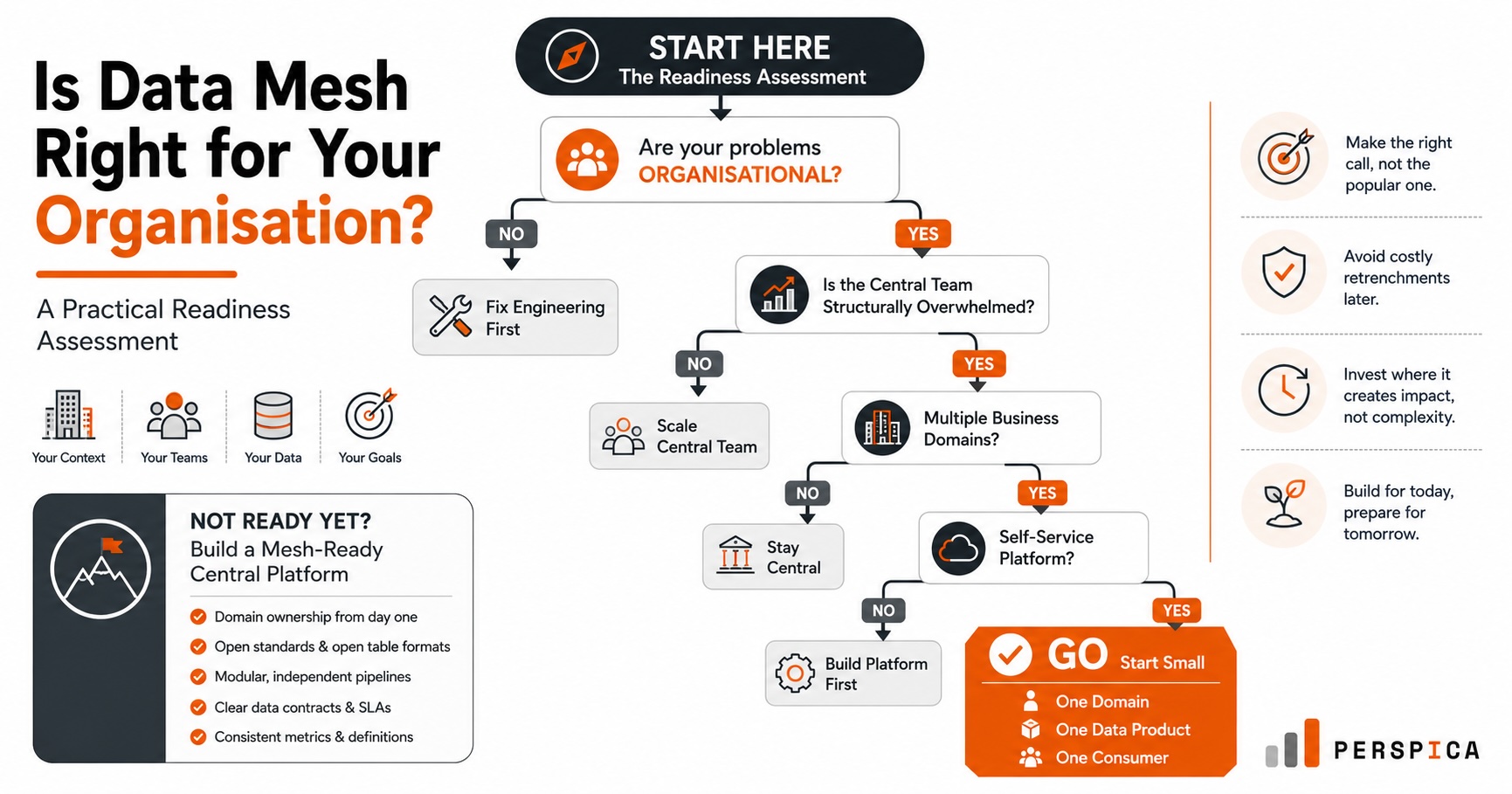
Most organisations ask "how do we implement data mesh?" before they have answered "should we implement data mesh?" They do all the ground work - platform is already selected, the programme has been assigned a name, the roadmap is presented to the board. But is data mesh even right for the organization? This question seldom gets the attention it deserves.
Data mesh is not right for every organisation. It may not be right for the organisations at the time when they decide to attempt it.
It is not about evaluating whether data mesh is a good idea. It is whether your organisation is the kind of place where data mesh can actually work. More importantly, will it work right now?
This post is the honest assessment that should happen before any platform is selected, any vendor is engaged, and any transformation programme is announced.
of organisations attempting data mesh report meaningful domain ownership after two years (ThoughtWorks, 2026)
of failed data mesh programmes selected tooling before defining their ownership model (Gartner, 2025)
typical time to reach scaled data mesh maturity in organisations that succeed (ThoughtWorks, 2026)
Why This Question Is Rarely Answered Honestly
There are typically three forces at play that make honest assessment difficult for organizations.
The first is vendor momentum. Once a vendor has been engaged, their incentive is to confirm that data mesh is the right solution and that their platform is the right way to implement it. Really that is how sales cycles work. But it is not a substitute for independent assessment.
The second is executive enthusiasm. Data mesh is intellectually compelling. It resonates with CDOs who have watched centralised data teams become bottlenecks. It connects to broader themes about agility and autonomy that leadership finds attractive. Enthusiasm is not evidence of fit.
The third is peer pressure. Zalando did it. JPMorgan did it. Intuit did it. If your peers are implementing data mesh, the pressure to follow is real. But in those organisations the conditions were perfect. They had the scale, the domain complexity, the engineering maturity that made data mesh the right answer for them. Those conditions do not automatically apply to you.
When Data Mesh Is Compelling
The following conditions are condusive for Data Mesh initiatives:
You have genuinely distinct data domains with different expertise. The Sales domain, the Finance domain, the Operations domain - each domain produces data that requires deep business knowledge to define, validate, and maintain correctly. The central data team regularly struggles with the business meaning and gets it wrong. This is simply because they lack domain knowledge, not becuase they are incompetent. Observe closely. Is this friction is primary source of data quality problems? Data Mesh addresses it directly.
Your central data team is a confirmed bottleneck. There is always a backlog of tickets that your central data team is constantly trying to cope with. Observe how long each request takes? Do you often hear "we are waiting for the data team to respond"? Are your AI initiatives stalled because data preparation cannot keep pace? These are symptoms of a centralised model slowing down the whole organisation. Data mesh solves this structurally.
Data quality directly affects revenue, risk, or regulation. Banks, insurers, telcos, health data platforms. These are industries where wrong data has immediate business consequences. In these environments, the cost of untrustworthy data is high enough to justify the investment required to distribute accountability to domain experts.
You have the engineering maturity to support decentralisation. Organisations that already practice DevOps, use infrastructure-as-code, have CI/CD pipelines, and embed engineers in product teams have the organisational muscle memory that data mesh requires. Domain teams can absorb data engineering responsibility because the pattern of embedded technical capability already exists.
You are willing to sustain an eighteen to twenty-four month investment before clear ROI. As we discussed in Part 5, data mesh is a long-term organisational transformation. If leadership will not defend the programme through the difficult early period, success is unlikely regardless of how well everything else is set up.
When Data Mesh Is the Wrong Answer
This is the section that vendor content almost never includes.
Your organisation has fewer than three or four distinct data-producing domains. Is your data landscape is relatively homogeneous i.e. one primary source system, one analytics team, a handful of consumers? Then data mesh is not right for you - just now. Data mesh adds organisational complexity that produces no benefit in such environments. The bottleneck problem it solves does not exist at your scale. A well-structured central team with good tooling is better.
Your data problems are technical, not organisational. In your observation do you see the following - pipelines break because they are poorly engineered, data is wrong because source systems are unreliable, data is slow because your infrastructure is underpowered. These are technical problems and reorganising into a mesh is not the answer. Distributing ownership of technically broken data = broken data with more owners. Fix the engineering first.
You have not yet solved basic data quality. Data mesh assumes domain teams will produce trustworthy data products. If the organisation does not have the discipline or the tooling to enforce quality standards, distributing ownership distributes the quality problem. You need a foundation of data reliability before you can distribute responsibility for it.
Your domain teams have no data engineering capability and no realistic path to building it. Data mesh requires domain teams to produce and maintain data products. If your Sales team has no data engineers and no budget to hire any, and no prospect of either, the ownership model cannot function. The responsibility lands on people who cannot fulfil it.
Executive commitment will not survive the first twelve months without visible results. If the organisation's leadership culture demands ROI evidence within a year, data mesh is premature regardless of everything else. The transformation takes longer than that to produce the kind of results leadership can point to. Attempting it without that patience produces a half-built mesh, abandoned ownership models, and organisational cynicism that makes the next attempt harder. Organisations end up in a state that is worse than when you started.
If You Are Small - Build for the Future You Will Have
There is a tension in the advice "data mesh is overkill at ten people, use a centralised model." The advice is correct for today when the organisation is small. But it contains a hidden cost.
The centralised model does not stay neutral as the organisation grows. It accumulates technical debt, organisational habits, vendor relationships, and political structures. The people who built it become the people who own it. The processes that depend on it become the processes that resist changing it. By the time the organisation is large enough that data mesh becomes necessary, the centralised model has cemented itself. The transition to data mesh at that stage becomes a painful, expensive and politically charged exercise.
So the honest advice is "use central now, but build it in a way that does NOT make the switch painful later."
Four things a small organisation can do right now that cost almost nothing today but preserve the option to distribute ownership later without a traumatic restructuring:
Name data owners by domain from day one even if one person holds multiple roles. In a ten-person company, one analyst might be both the Sales owner and the Finance owner. That is fine. The habit of naming a domain owner means that when the organisation grows and those roles split, the ownership model already exists conceptually. The transition becomes evolutionary rather than revolutionary. In most small organisations, nobody is named as a data owner. Data belongs to whoever built it. When the organisation grows, this becomes the ownership vacuum. The cost of fixing it is high because it requires changing habits, not just adding a role.
Document the business meaning of every key metric at the point of creation. When you define "active customer" for the first time, write it down. Not in a catalog - just in a shared document. Name the person who defined it. When the definition changes, document the change. This costs almost nothing at ten people. At five hundred people, the absence of this documentation is one of the primary causes of the semantic drift and domain blindness that makes centralised data models untrustworthy. It is far easier to maintain a definition than to reconstruct one years later after the person who understood it has left the company.
Build the data layer on open formats from the start. Prefer open standards over proprietary abstractions wherever practical. Open table formats such as Iceberg, Delta Lake and Parquet make future architectural evolution significantly easier because they separate the data from the processing engine. Organisations that build on proprietary formats often carry a much higher cost of change. Avoiding lock-in preserves the freedom to evolve your architecture and eventually your ownership model as the organisation grows.
Keep the data layer modular even when it is managed centrally. Design pipelines so that Sales data, Finance data, and Operations data each have clear boundaries - separate schemas, separate lineage, clear source attribution - even if a single team manages all of them. This is not data mesh. It is a centralised system with the internal structure that a mesh would have. When the time comes to hand ownership to domain teams, the boundaries already exist.
The best time to prepare for data mesh is before you need it. Not by implementing it, but by building a centralised model that does not fight you when the time comes.
The assessment checklist
Before your next data platform evaluation, before the vendor shortlist, before the RFP - run through these five questions honestly. They are not a scoring framework. They are a structured conversation that your organisation should have.Question 1: Do your data quality problems consistently trace back to domain knowledge gaps - situations where the central team built the right thing technically but the wrong thing in business context? If yes, data mesh directly addresses the root cause. If the problems trace to technical debt, infrastructure limitations, or poor engineering - data mesh is the wrong prescription.
Question 2: Is your central data team regularly overwhelmed, unable to keep pace with the organisation's data needs regardless of how many people you add? If yes, the centralised model is broken and distribution is the answer. If the team is manageable with more resources, scaling the central team is simpler than building a mesh.
Question 3: Do you have or can you realistically build the self-serve infrastructure that makes domain ownership tractable? Without it, domain ownership is a burden. The platform team must go first. If you cannot commit to building it, do not assign the accountability that depends on it.
Question 4: Are your domain team leaders willing and able to accept accountability for data quality - with real consequences if their products fail? If the answer is no or unclear, the ownership model will not hold. And this willingness goes beyond the meeting room. It shows up when a data quality issue is reported and domain team leader takes ownership.
Question 5: Will your executive sponsor still be defending this programme after eighteen months, when the catalog is thin and the first data products are only just appearing? This is the question that determines everything else. If the answer is uncertain, do not start.
Three or more strong yes answers: data mesh is worth pursuing seriously. Two yes answers: address the gaps before starting. One or fewer: solve the immediate data problems with simpler tools first.
The Incremental Path
After an honest assessment, if the answer is "not yet" that is not a failure. It is useful information that most organisations do not get before spending millions on a transformation that was premature.
The right incremental path is to start with one domain, one data product, one consumer. Not as a pilot in the programme management sense - as a genuine test of the ownership model. Pick the highest-value, lowest-politics use case you can find. Give that domain team real authority, real resources, and real accountability for one data product. See what breaks.
What breaks in that first product is the curriculum for the rest of the organisation. It tells you which governance gaps are real, which infrastructure investments are actually needed, and whether the domain team accountability model holds under pressure. That learning is worth more than eighteen months of architecture planning.
The question is never "are we ready for data mesh?" The question is "what is the smallest thing we can do right now that moves us meaningfully toward domain ownership?" Start there.
Coming next - Part 7: Your AI Strategy Has a Data Problem. Here Is What It Is.