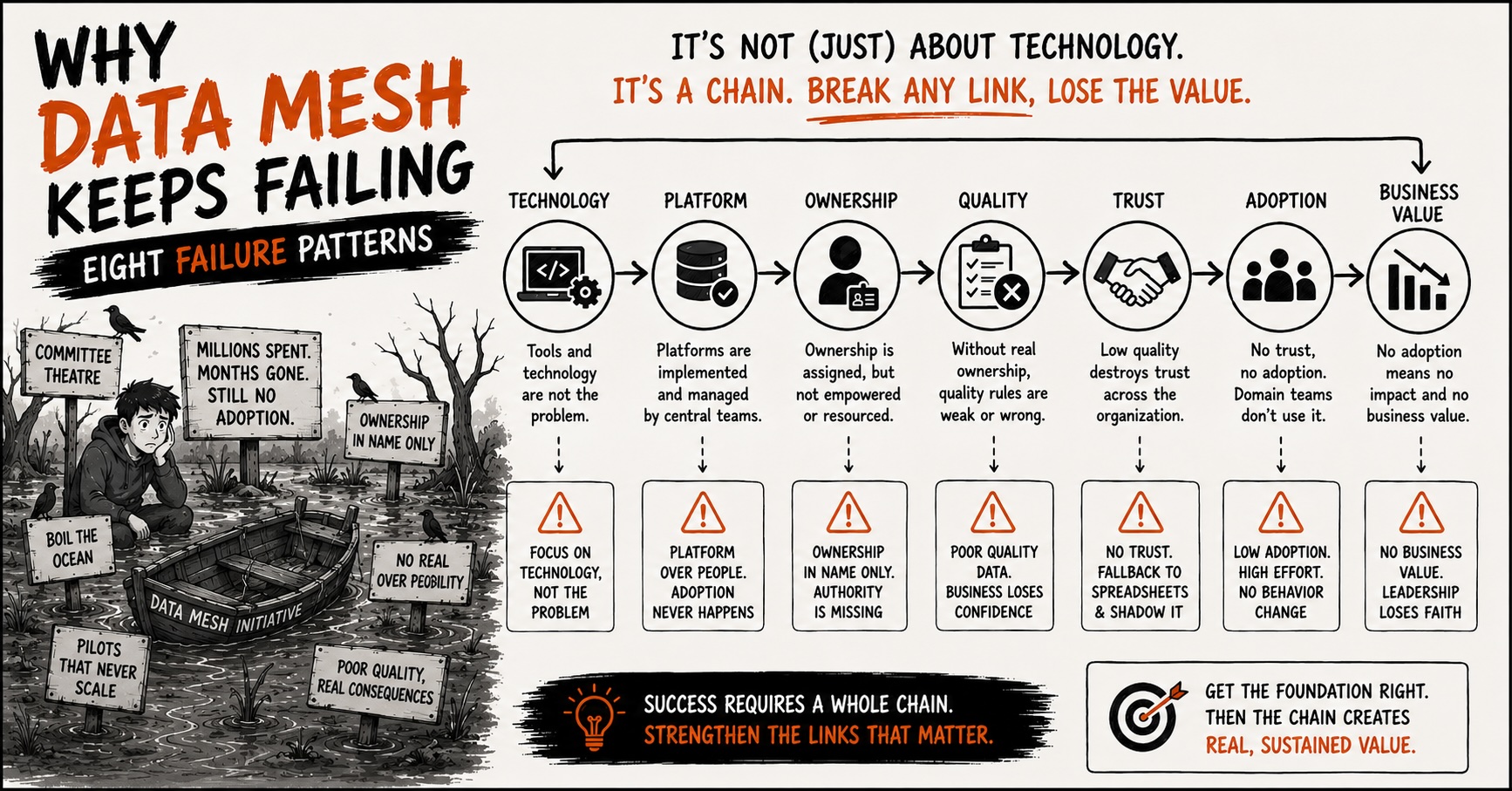
I want to describe a scene that plays out across enterprises more often than anyone in the industry likes to admit.
A data governance platform is live for fourteen months. The catalog is populated. The data lineage is mapped. The ownership fields are filled in. There is a discovery portal with a search bar and filters and a clean UI.
I sit with the implementation team and ask one question: "How are your domain teams using the discovery portal? Any external users?"
The answer, almost every time, is the same. "Not yet. We are still working on adoption."
Fourteen months. No adoption. Millions spent. And the central data team — the same team that always owned the data — is still the only team using the platform they built to give ownership away.
Data mesh does not fail because the technology or idea is wrong. It fails because organisations change the vocabulary without changing the power structures underneath.
This is the most honest thing I can say. The technology rarely fails. The operating model does.
of big data and data mesh projects fail to deliver expected value (Gartner, 2025)
of organisations have the governance maturity required for data mesh (Gartner, 2025)
of data mesh initiatives stall at the pilot stage and never scale (Thoughtworks, 2026)
Two Families of Failure
The reasons why data mesh initiatives fail can be categorised into two types:
The first type is organisational failures — these kill most programmes before they produce anything. They are about power, accountability, and culture. They are the hardest to fix because they require people to change, not tools.
The second type is execution failures — these kill programmes that survived the politics but got the implementation wrong. They are more technical but still rooted in organisational choices.
The organisational failures are far more common. And far more fatal.
The Organisational Failures
Failure Mode 1 — Treating It as a Technology Project
This is the most common cause of failure. A team reads about data mesh, gets excited, selects a platform, implements it, and calls it done. The tools are in place. The transformation is not.
I have seen this with Cloudera — a platform I have worked with directly across multiple enterprise implementations. The platform was world-class. The governance features were genuinely powerful. And in every case, the central data team implemented it, managed it, and used it. The domain teams were informed, occasionally consulted, and entirely absent from the day-to-day ownership of data.
The platform changed. The model did not.
Data mesh is, as Zhamak Dehghani described it, sociotechnical. The social half is not optional. If your first conversation about data mesh is about which platform to buy, you have already made the defining mistake.
Failure Mode 2 — Ownership in Name Only
Organisations announce that domain teams now own their data. They fill in the ownership fields in the catalog. They send an email. They update the org chart.
And then nothing changes.
The domain teams have the label but not the authority. They have no budget to hire data engineers. They have no power to define quality standards. They have no mechanism to enforce SLAs. When something goes wrong with the data, they escalate to the central team — the same team they were supposed to replace.
This is the most insidious failure mode because it looks like progress. The catalog shows owners. The slides show domain teams. The programme appears to be working. And underneath it all, the central team is still doing everything.
Real ownership requires three things that organisations routinely withhold: budget, skills, and accountability. Ownership without budget is responsibility without authority. Ownership without skills is expectation without capability. Ownership without accountability is simply a name in a catalog.
None of the three works on its own.
A colleague recently described an MDM solution at a major telco in the region. The platform had been live for years. It had been upgraded twice. The investment was real and sustained.
Nobody was using it. Business teams were still working off Excel sheets.
I asked him why. "People do not trust the quality," he said.
I asked why the quality was poor. "The business teams are not configuring the quality rules. The technical implementation team is expected to do it."
There it is. Quality rules encode business meaning — what constitutes a valid customer record, what makes an address complete, what a legitimate product code looks like. Only the business domain knows these things. When the technical team is expected to define them, they write rules that are technically valid and semantically meaningless. The data passes every check. It is still wrong. And the business teams, who know it is wrong, go back to their spreadsheets.
The MDM platform did not fail. The ownership model failed. And it failed in exactly the same way it fails in data mesh programmes, data catalogs, and data lakes — whenever accountability is placed with the people who understand the technology rather than the people who understand the data.
Failure Mode 3 — The Governance Theatre
A governance committee is formed. Standards are documented. Monthly meetings are scheduled. Domain teams are asked to self-certify compliance against a checklist.
Six months later, the standards document has not been updated. The monthly meetings have been cancelled twice for diary conflicts. The self-certification forms are sitting in a shared drive unread.
This is governance theatre — the performance of governance without the substance of it. And it happens in almost every enterprise that tries to build a federated governance model through human process rather than computational enforcement.
Dehghani's fourth principle is explicit: governance must be computational — encoded in the platform, automatically enforced at the point of publication, not managed by a committee reviewing spreadsheets. If a standard can only be enforced by a person, it will eventually not be enforced at all.
Failure Mode 4 — The "Boil the Ocean" Launch
An enterprise decides to implement data mesh across all forty domains simultaneously. Many months are spent on architecture planning, governance frameworks, catalog selection, and standards documentation. By the time anything is built, leadership has changed, priorities have shifted, and the programme quietly dies without having shipped a single data product.
The enterprise instinct is to get everything right before starting. Data mesh requires learning by doing. These two things are incompatible.
Every successful implementation I am aware of started with one domain, one data product, one consumer. That first product is less important for its business value than for what it teaches the organisation about its own failure modes.
The Execution Failures
Failure Mode 5 — Relabelling Pipelines as Data Products
Teams rename their existing ETL pipelines as data products, add them to the catalog, and declare victory. The pipeline has no SLA. No defined consumers. No quality metrics. No schema documentation. No owner who feels accountable for it. It is a pipeline with a new label.
This is the most common execution failure — and the most seductive, because it looks like progress on a dashboard. The catalog entry count goes up. The data product count goes up. Nothing actually changes.
Apply Dehghani's eight characteristics to your organisation's most celebrated data product. Is it discoverable without asking someone? Does it have a committed quality SLA? Is it self-describing for a first-day analyst? If it fails three or more of the eight characteristics, it is not a data product.
We covered this in detail in Part 3. The diagnostic still stands.
Failure Mode 6 — The Empty Catalog
The organisation invests heavily in a data catalog. It is populated with entries, documented with metadata, and announced to the organisation. By whom? The central IT team. Then nobody uses it.
A data catalog is only valuable when it becomes the first place people look for data. That requires a network effect — enough trustworthy, well-documented data products in the catalog that going anywhere else is clearly worse. Getting to that critical mass requires active programme management, not passive rollout.
My discovery portal question from the opening of this post — "Any external users?" followed by "No" — is the empty catalog failure in one exchange. The platform exists. The adoption never arrived. Because adoption requires trust, and trust requires the catalog to contain things worth trusting.
Failure Mode 7 — No Self-Serve Infrastructure
Data mesh's third principle — self-serve data infrastructure — is the one organisations most consistently underinvest in. Domain teams are asked to own their data. But if they have to file tickets to provision infrastructure, request catalog access, or get pipelines deployed, they are not self-serving. They are depending on the same central team they were supposed to replace.
Without genuine self-serve capability — one-click pipeline scaffolding, automated quality testing, self-service catalog publishing — domain ownership becomes a burden rather than an empowerment. Domain teams have the accountability without the capability. That breeds resentment, workarounds, and eventual abandonment.
Failure Mode 8 — No Data Contracts
Domain teams publish data products but make no formal commitments about schema stability, field semantics, or update frequency. Downstream consumers build pipelines on top of those products. The producer team makes a "small" schema change — renames a field, changes a data type — without notifying consumers. Downstream pipelines break silently. Trust in data products collapses.
This is Bill Inmon's integration concern made operational. Without contracts, distributed data inherits all the fragility of distributed systems and none of the reliability guarantees.
Every data product published to consumers needs a versioned data contract: schema and field definitions, quality SLAs, a deprecation policy with minimum notice, and a contact point for questions. Not as a document. As a machine-enforced commitment that the platform validates before any change goes live.
The Meta-Pattern
Looking across all eight failures, one pattern becomes visible.
Most data mesh programmes fail because they adopt the vocabulary of data mesh without changing the power structures that the vocabulary was designed to change.
You can have a catalog, a lakehouse, a governance framework, a product owner title, and a mesh architecture diagram. And still be running exactly the same centralised, pipeline-centric, low-trust data organisation you started with. The words changed. The system did not.
The programmes that succeed share one thing: leadership treated the organisational transformation as the primary project and the technology as the implementation detail. Not the other way around.
That sequencing — organisation first, technology second — is the most important thing to get right. And it is the thing that procurement cycles, vendor relationships, and the path of least resistance conspire to reverse, every time.
Coming next — Part 5: The Social Contract of Data Mesh — Why the hardest part of implementation has nothing to do with data